
Soil Calculator
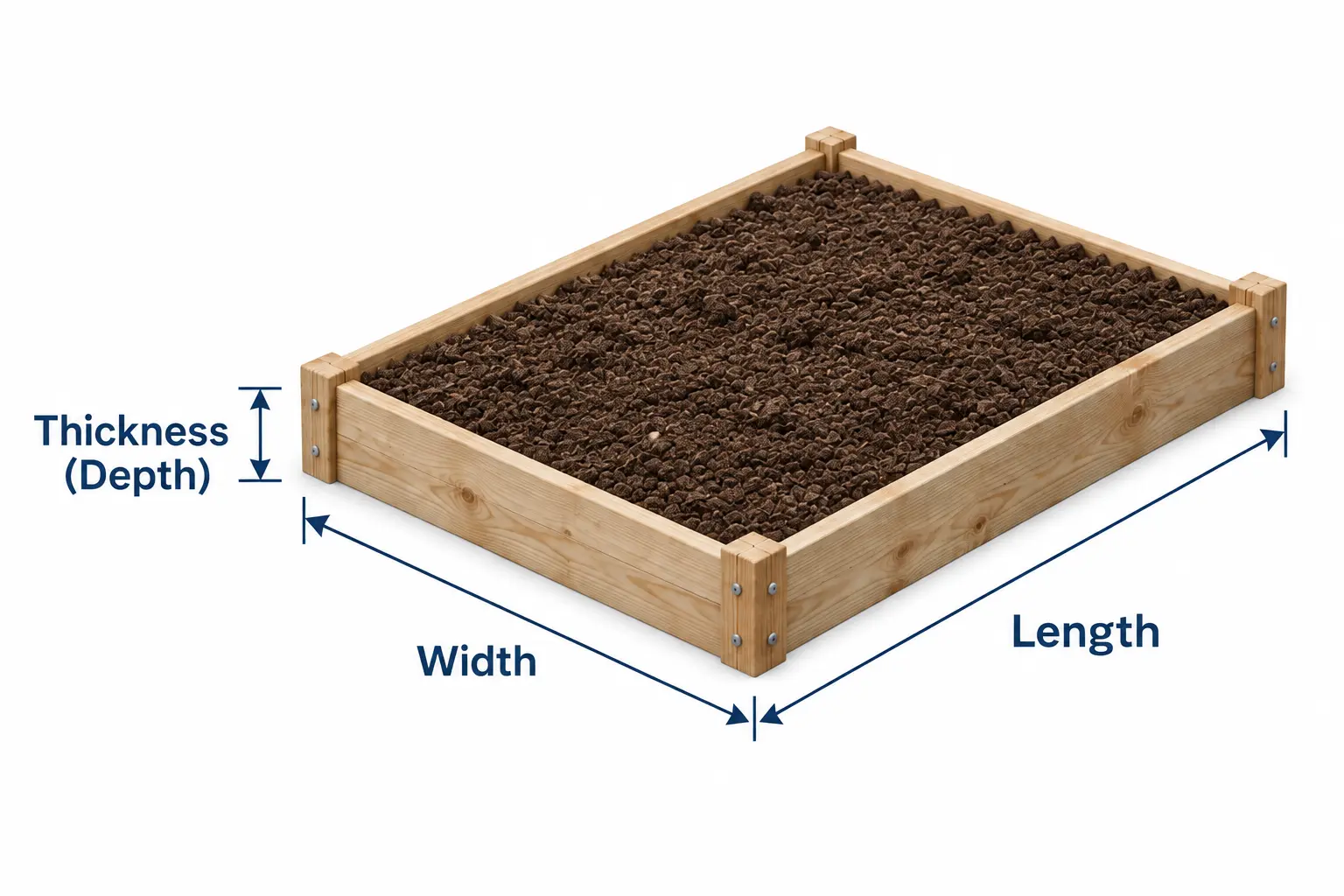
Calculate how much soil you need based on your project dimensions and desired depth.
Related Calculators
How to Use This Calculator
- 1Measure the length and width of the area you need to fill.
- 2Determine the soil depth you want to calculate.
- 3Enter the length, width, and depth into the calculator.
- 4Select the appropriate unit for each measurement.
- 5Click Calculate to estimate the required soil volume.
- 6Review the calculated soil volume in cubic feet and cubic yards.
Common Uses
- Garden beds
- Raised garden beds
- Lawn and grass areas
- Landscaping projects
- Filling rectangular planting areas
- Topsoil projects
- Soil replacement or additions
How Much Soil Do I Need?
The amount of soil you need depends on the length, width, and depth of the area you need to fill. For a rectangular area, multiply the three dimensions after converting them to compatible units.
For example, a garden bed that is 10 feet long, 4 feet wide, and 1 foot deep has a volume of 40 cubic feet.
The calculated volume represents the geometric amount of soil required to fill the dimensions entered.
Soil Volume = Length × Width × Depth
Soil Calculator for Raised Beds
Raised beds are a common use for a soil volume calculation. Measure the inside length and width of the bed and determine the depth of soil you plan to fill it with.
For example, a 4-foot × 8-foot rectangular raised bed filled to a depth of 1 foot requires 32 cubic feet of soil.
This calculation determines the volume of the space being filled. The type of soil or growing medium you choose does not change the geometric volume calculation.
Soil Volume = Length × Width × Depth
Garden Soil Calculator
For garden beds and planting areas, measure the area you want to fill and determine the soil depth.
For a rectangular garden bed, multiply the length, width, and depth to calculate the required soil volume.
The same calculation can be used when adding new soil, replacing existing soil, or filling a prepared rectangular planting area.
Volume = Length × Width × Depth
Topsoil Calculator
Topsoil is commonly measured by volume when estimating material for landscaping and lawn projects.
The calculation is based on the size of the area and the depth of topsoil being added. The calculator does not need to know the soil brand or product type to calculate geometric volume.
If you are purchasing topsoil by cubic yard, convert the calculated cubic-foot volume to cubic yards by dividing by 27.
Cubic Yards = Cubic Feet ÷ 27
Topsoil Calculator for Square Feet
If you already know the area in square feet, you can calculate the required soil volume using the square footage and soil depth.
First convert the depth from inches to feet, then multiply the square-foot area by the depth in feet to calculate cubic feet.
To convert the result to cubic yards, divide by 27. This produces a combined divisor of 324 when square feet and depth in inches are used.
For example, a 1,000-square-foot area with 3 inches of topsoil requires approximately 9.26 cubic yards.
Cubic Yards = Square Feet × Depth in Inches ÷ 324
Topsoil in Cubic Yards
Topsoil is often purchased or delivered by cubic yard for larger landscaping and lawn projects.
One cubic yard contains 27 cubic feet. Once you calculate the soil volume in cubic feet, divide by 27 to convert it to cubic yards.
For example, 81 cubic feet of soil equals 3 cubic yards.
Cubic Yards = Cubic Feet ÷ 27
Soil for Lawns and Grass
A soil volume calculation can also be used when estimating soil or topsoil for a lawn area.
Measure the length and width of the area, determine the intended soil depth, and calculate the volume using the same rectangular volume formula.
The calculator estimates volume based on the dimensions entered. It does not determine the appropriate soil depth or lawn installation requirements for a particular property.
Volume = Length × Width × Depth
Potting Soil Calculator
Potting soil can also be measured by volume when filling containers or other rectangular spaces.
The basic volume relationship remains length × width × depth. However, containers and planting spaces can have shapes other than rectangular boxes.
The current calculator should only be used for the shapes and dimensions supported by its interface. For an irregular container, divide it into measurable sections where practical or use the appropriate geometric method separately.
Volume = Length × Width × Depth
Soil Depth and Volume
Soil depth directly affects the amount of material required. If the length and width remain the same, increasing the depth increases the calculated volume proportionally.
Doubling the depth doubles the calculated volume, while halving the depth halves the calculated volume.
The depth entered into the calculator should represent the actual layer or fill depth you are trying to estimate. Different projects can require different depths based on the project design, existing conditions, plants, grading, and other factors.
Soil Volume in Cubic Feet and Cubic Yards
Soil can be expressed in either cubic feet or cubic yards. One cubic yard contains 27 cubic feet.
Cubic feet are useful for smaller calculations and manual verification, while cubic yards are commonly used when discussing larger quantities of bulk soil and topsoil.
For a rectangular area, calculate cubic feet first and then divide by 27 to convert the result to cubic yards.
1 cubic yard = 27 cubic feet
How to Measure for a Soil Calculation
Before using the calculator, measure the space that will actually be filled. For a rectangular area, measure the length, width, and depth of the soil layer.
For a raised bed, measure the usable interior dimensions rather than automatically using the outside dimensions of the frame.
For a lawn or garden area, measure the portion of the area where soil will actually be placed.
Keep the measurement units clear when recording your dimensions. The calculator's unit selectors allow supported units to be entered for each measurement.
Soil Calculator Formula
The basic formula for a rectangular soil calculation is length multiplied by width multiplied by depth.
When all measurements are expressed in feet, the result is cubic feet. If depth is measured in inches, divide the depth by 12 to convert it to feet before calculating the volume.
The calculator converts the supported input units before performing the volume calculation.
Volume = Length × Width × Depth
Soil Calculation Example
Suppose a rectangular garden bed is 12 feet long, 5 feet wide, and has a soil depth of 6 inches.
First convert the depth from inches to feet: 6 ÷ 12 = 0.5 feet.
Calculate the area: 12 × 5 = 60 square feet.
Calculate the soil volume: 60 × 0.5 = 30 cubic feet.
Finally, convert cubic feet to cubic yards: 30 ÷ 27 = approximately 1.11 cubic yards.
The base calculated volume is therefore approximately 30 cubic feet, or 1.11 cubic yards.
30 ÷ 27 = approximately 1.11 cubic yards
Common Soil Calculation Mistakes
A few common measurement and unit mistakes can lead to an incorrect soil volume estimate.
- Using the wrong depth: Depth has a direct effect on the required volume. Make sure the depth represents the soil layer you actually want to calculate.
- Mixing inches and feet: If length and width are in feet but depth is in inches, convert the depth to feet before multiplying.
- Confusing square feet with cubic feet: Square feet describe the area being covered, while cubic feet describe the volume of soil required. Depth connects the two measurements.
- Forgetting the cubic-yard conversion: One cubic yard equals 27 cubic feet. Divide cubic feet by 27 to convert the result to cubic yards.
- Measuring the wrong dimensions: For raised beds and containers, make sure the dimensions represent the space that will actually be filled.
- Assuming all soil products have the same purchasing quantity: Bulk soil and bagged soil can be sold using different units and package sizes. The geometric volume calculation does not automatically determine how many bags or how much weight a specific product represents.
Soil Volume vs. Soil Weight
Soil can be purchased by volume or, depending on the product and supplier, by weight. Volume and weight are different measurements and cannot be directly converted without additional information.
The weight of a given soil volume can vary because different soils and soil products can have different densities, moisture levels, and compositions.
For this reason, do not convert the calculator's volume directly into tons or pounds using a universal density value. If purchasing by weight, use the density or product information supplied for the specific soil product.
Soil Bags and Product Coverage
Bagged soil products are often sold using package-specific volume or coverage information.
The number of bags required depends on the volume contained in the particular product. Two soil products can have different bag volumes or stated coverage even when both are marketed as garden soil.
For purchasing, compare the calculated volume with the volume or coverage information provided for the specific product rather than assuming a universal number of bags per cubic yard.
Irregular Soil Areas
The current calculator is designed around the rectangular dimensions provided by its interface.
If a project has an irregular shape, divide the area into smaller measurable sections where practical. Calculate the volume of each section separately and add the results together.
For circular, triangular, sloped, or otherwise irregular areas, use the appropriate geometric method rather than assuming a rectangular calculation automatically represents the entire project.
Total Volume = Volume 1 + Volume 2 + Volume 3 + ...
Checking Your Soil Calculation Manually
You can verify a rectangular soil calculation by calculating the area, converting the depth, calculating cubic feet, and then converting to cubic yards.
First multiply length × width to get square feet. Then divide the depth in inches by 12 to convert it to feet.
Multiply square feet by the depth in feet to get cubic feet. Finally, divide cubic feet by 27 to get cubic yards.
If your manual calculation differs substantially from the calculator result, check the measurements, units, and depth entered.
Cubic Feet ÷ 27 = Cubic Yards
Soil Calculation Quick Reference
Use these formulas when checking a rectangular soil calculation manually or converting between common volume measurements.
| Calculation | Formula |
|---|---|
| Volume | Length × Width × Depth |
| Depth in feet | Depth in inches ÷ 12 |
| Cubic feet | Square Feet × Depth in Feet |
| Cubic yards | Cubic Feet ÷ 27 |
| Cubic yards from square feet | Square Feet × Depth in Inches ÷ 324 |
Internal Calculator Resources
If you need to calculate the square footage of an area before estimating its soil volume, use the Square Footage Calculator.
For another landscaping material volume calculation, you can also use the Mulch Calculator or Gravel Calculator.